
Operational and tax compliance: evidence ready before every decision
Paying a supplier, issuing an invoice or recording working hours are decisions you will later have to prove. FieldWy turns each obligation into a process with owners, due dates, documents and an audit log, so the evidence exists before anyone asks for it.
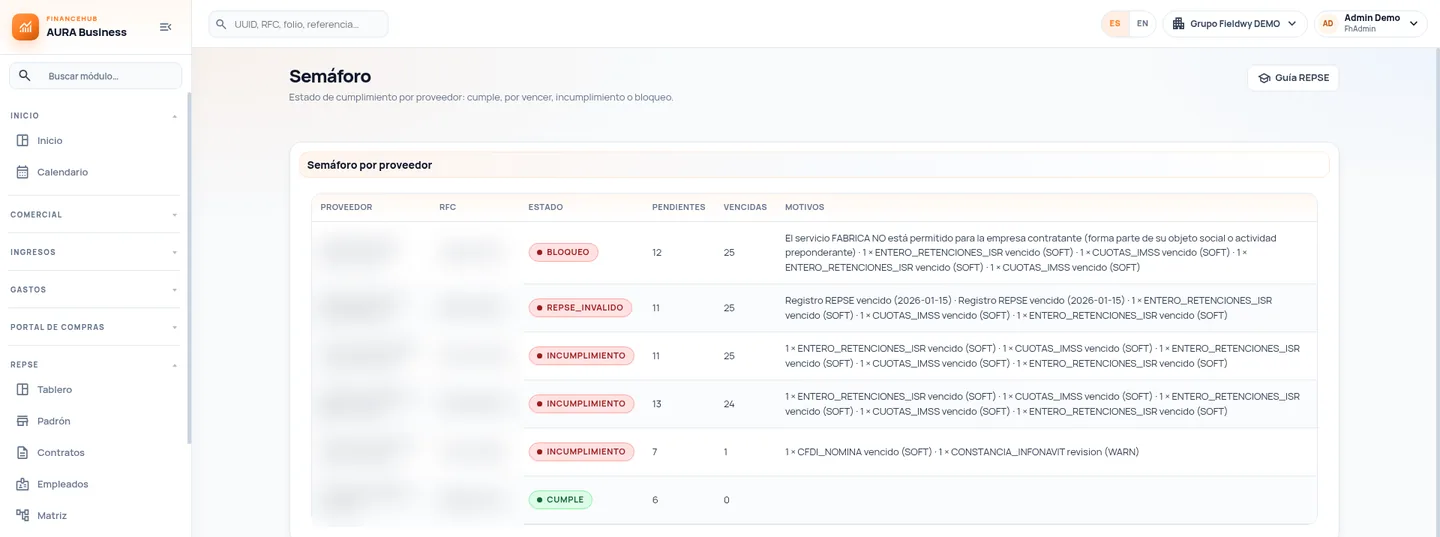
Where finance and procurement compliance is won or lost
Each area has its own rules, documents and control point. We handle them on the same platform.
REPSE and specialized subcontracting
Registry, matrix of allowed services, evidence calendar and payment block when the file is incomplete.
Learn moreCFDI and self-invoicing
A portal where your customers generate their CFDI 4.0 invoice from their ticket or reference, stamped through a certified PAC.
Learn moreSupplier document control
Onboarding, document review, purchase orders and CFDI intake validated against the order before Accounts Payable.
Learn moreTraceability and evidence
A log of every action, document versions, role-based permissions and exportable audit files.
Learn morePrinciples that show in an audit
Every obligation has a date
Each document has a frequency, a deadline and an owner. Expirations are visible before they happen.
Control before payment
Evidence is checked before payment is released or the invoice is issued, not at year-end.
One file per supplier and period
Contract, registration, receipts and acknowledgments in one place, with versions and expiration dates.
A log that cannot be edited
Who approved, rejected or authorized an exception, with date and reason. Events are never deleted.
AI proposes, your team decides
AURA AI OS reads documents and suggests checks; the decision and sign-off belong to your team.
Third parties inside the process
Suppliers and customers use their own portal: they see what is missing, upload files and learn why something was rejected.
The rules behind each area
An informational summary of the provisions that usually apply. The specific obligation depends on each contract and your advisor.
| Topic | What it requires | Legal basis |
|---|---|---|
| Specialized subcontracting | Staff outsourcing is prohibited; specialized services or works are allowed if they are not part of the client’s corporate purpose or main business activity, under a written contract, with joint liability for the client. | Federal Labor Law (LFT), arts. 12, 13 and 14 (reform published April 23, 2021) |
| REPSE registration | The provider must be listed in the STPS public registry and renew its registration every three years. | LFT, art. 15; repse.stps.gob.mx |
| Provider reports | Every four months the provider reports its contracts to IMSS (ICSOE) and INFONAVIT (SISUB), no later than the 17th of January, May and September. | Social Security Law, art. 15-A; INFONAVIT Law, art. 29 Bis |
| Deduction and VAT | To deduct and credit VAT, the client checks the registration when paying and obtains copies of payroll CFDIs, withholding payments, IMSS and INFONAVIT contributions, plus the provider’s VAT return and payment receipt. | Income Tax Law, art. 27-V; VAT Law, art. 5-II; Federal Tax Code, art. 15-D |
| CFDI 4.0 | Invoices are issued as CFDIs certified by SAT or an authorized certification provider (PAC). Since April 1, 2023, version 4.0 is the only valid version. | Federal Tax Code, arts. 29 and 29-A; Annex 20 |
| Record retention | Accounting records and supporting documents are generally kept for five years. | Federal Tax Code, art. 30 |
| Working-hours records | The working-hours reform gradually reduces the workweek from 48 to 40 hours between 2026 and 2030 and requires electronic records of working hours. | LFT, art. 132-XXXIV (see the workweek guide) |
Processes that usually go together
Working hours and the 40-hour workweek
Electronic time records, overtime and evidence for inspections.
Learn moreDocument courier
Shipping, acknowledgment and verification of physical files with traceability of every delivery.
Learn moreLegal document review
Review of powers of attorney, signing authority and expiration dates within the case file.
Learn moreWhat clients usually ask
Another question? Use the form on this page.
What does operational and tax compliance mean at FieldWy?
Turning each obligation (a REPSE registration, a CFDI, a supplier document, a working-hours record) into a process step with an owner, deadline, evidence and log. The goal is for proof of compliance to exist at the moment of the decision, not to be rebuilt later.
Does it replace our legal or tax advisor?
No. The platform organizes the evidence and applies the rules your company defines with its advisor: which services are specialized, which documents each contract requires and when a payment is blocked. Legal interpretation remains with your team and advisors.
Does it integrate with our ERP?
Yes. The portals exchange data with your ERP or accounting system through APIs, web services or SFTP: suppliers, purchase orders, received and issued CFDIs, and payment status.
How long is evidence kept?
Your retention policy sets the period. As a reference, the Federal Tax Code (art. 30) generally requires keeping accounting records and supporting documents for five years; some labor obligations or disputes may require longer.
Where should we start?
With the area that carries the most risk or volume: usually REPSE when you have recurring specialized services, the supplier portal when invoices arrive by email, or self-invoicing when customers ask for invoices every day.
For information only; this is not legal or tax advice. Regulatory references cite Mexican law in force as of November 2026 (Federal Labor Law, Social Security Law, INFONAVIT Law, Income Tax Law, VAT Law and Federal Tax Code) and the official STPS, IMSS, INFONAVIT and SAT portals. Specific obligations depend on each contract and should be confirmed with your advisor. Screens show demo data.
Tell us how you operate today
A specialist reviews your case and prepares the demo around a scenario similar to yours.
- Session with a specialist in finance and compliance processes.
- Your operation as the example, not a generic demo.
- Phased scope, defined with your team.